
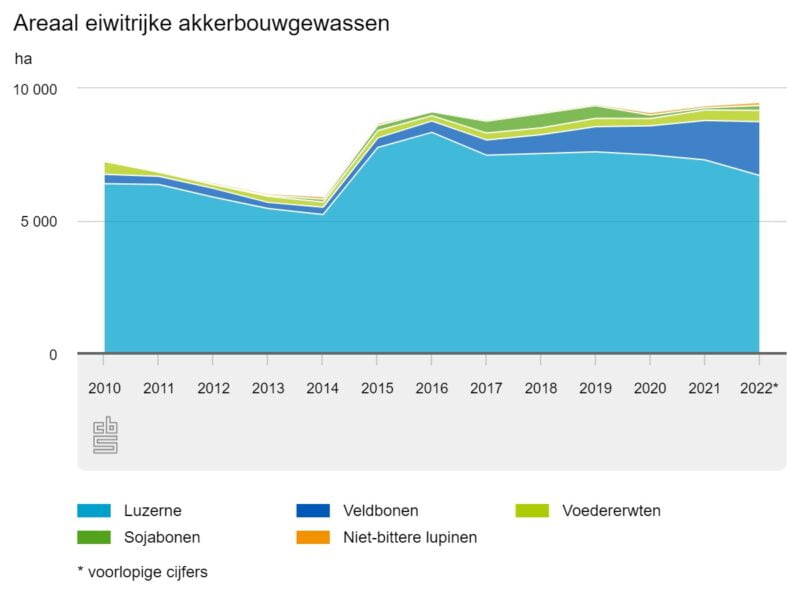
The cultivation of protein-rich crops such as alfalfa, field beans and soybeans increased slightly in 2022. The Dutch area increased by 1 percent compared to a year earlier. The area of soybeans in particular increased. This year, soybeans are grown on 185 hectares, more than twice as much as last year. This is evident from preliminary figures from the CBS agricultural census 2022.
9500 hectares
In the Netherlands, protein-rich crops are grown on 9,5 thousand hectares. The crops are grown for human consumption, as animal feed or as green manure. These crops are in the spotlight because of the role they play in the food transition (more vegetable proteins in the food package) and circular agriculture (home-grown protein for concentrated feed).
Soybeans and lupine beans are mainly grown in the Netherlands for human consumption, for example as a raw material for meat substitutes. Field beans and field peas are grown as forage crops.
Especially alfalfa
The protein-rich crops take up about 0,5 percent of the total Dutch agricultural area. The area mainly consists of alfalfa. The area of alfalfa has been decreasing for a number of years. In 2022, the area will be 6,7 thousand hectares, 8% less than a year earlier. Alfalfa is used as cattle feed and as green manure.
More field beans and lupins
There was growth in the areas of field beans and lupine. The area of field beans grew by 2022 hectares to 538 hectares in 2, an increase of 020 percent. The area of non-bitter lupine grew from 36 hectares in 84 to 2021 hectares this year (+120%).
EU soybean area virtually unchanged
In the European Union as a whole, the area of soybeans has hardly changed. In 2021, the area of soybeans in the EU was 940 thousand hectares, compared to 941 thousand hectares a year earlier.
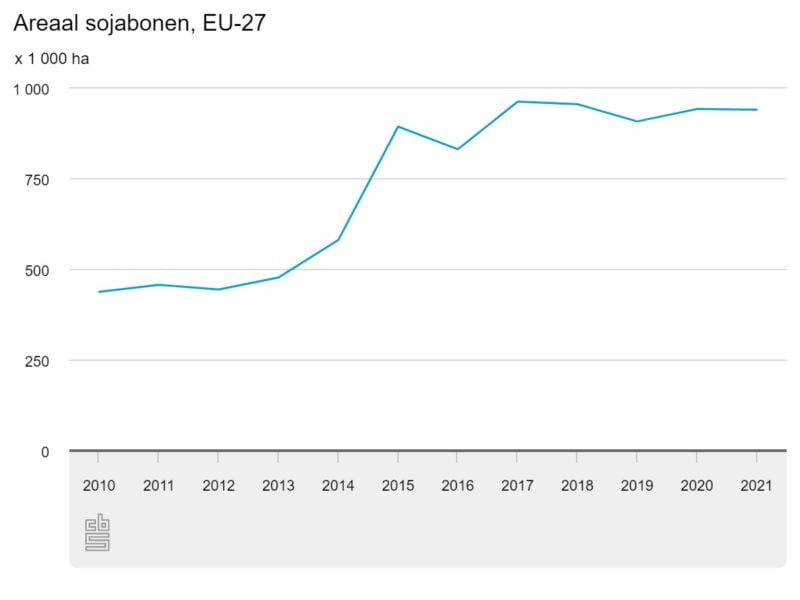
The EU aims to reduce dependence on imported soy by, among other things, growing more soybeans itself. It is mainly the EU countries Italy, France and Romania where soy is grown with an area of 285.000, 154.000 and 139.000 hectares respectively.

